Ethnohistorical Focus
The millenarian culture of Peru is the fruit of profound empirical knowledge and long, meticulous observation. The merit of the Incas was that they used and applied the ancient knowledge, customs and accomplishments of Andean man from centuries ago and used them properly to satisfy the needs of the expanded State.
It is surprising how the Inca organizational system was applied in a territory which took in a good part of the South American continent facing the Pacific Ocean. All this was carried out without having writing, therefore the transition of applied technology had to be oral and practical. The Inca State based its socioeconomic meshing on symmetrical and asymmetrical reciprocity, the redistribution of resources and exchange, this last feature emphasized between the coastal groups.
The question which arises is: How could a State be so organized when it didn't have anything like writing to establish its statistics, indispensable to economic management?
Quipus
It is fitting to point out that just the results of mathematical operations previously done on an abacus or yupana were knotted in the quipus. The abacus could be of carved stone or clay. Both had scoreboards that corresponded to the decimal system and one counted with the help of little stones or kernels of maize.
Quipus were a mnemonic system by means of which necessary information could be registered. It could be a matter of census news, of amounts of products and provisions conserved in state warehouses. The chroniclers also mention quipus with historical information but we have not yet discovered how they functioned. In the Inca state specialized personnel handled the cords and to the senior quipucamayo was in charge of the cords for a whole region or suyu.
Quipus continue to be used as mnemotechnical instruments in indigenous villages where they serve to register products of the harvest and animals of the community.
Subir
The Agriculture
The major worry of the inhabitants of the prehistoric Andean sphere was to achieve the greatest agricultural production possible. The configuration of the country was a constant challenge for the population which had to overcome vast coastal deserts, abrupt terrain in the highlands, wide punas covered with the typical high altitude ichu grass and hostile jungles. For each one of those environments so different from each other they had to invent appropriate techniques of cultivation and utilization.
The inhabitants of the Andes managed to overcome the difficulties of the surroundings owing to their ingenuity. On the slopes of ravines they constructed sophisticated terraces, on the coast and in the highlands they built canals and in the desolate punas they used the waru-waru and the cochas to increase moisture. Therefore, despite those hard and difficult environments, the inventiveness of man accomplished making the Andes one of the world centers of major importance for acclimatizing plants useful to man, including edible plants and plants needed to cure illnesses.
Subir
Musical Instruments
Music forms a close part of life of ancient Peru, the most diverse phases of development of its inhabitants are accompanied by happy or sad, solemn or festive music. Every region and every occasion possessed its own songs and dances that could not be exchanged or changed.
An Inca characteristic was the performance of music during agricultural labors on State lands, with which the hard work turned into pleasant gatherings.
The musical instruments used in corporal expression were different according to the dances to interpret, the constituents, the regions or the motives of the celebrations.
Flutes were one of the most popular instruments. Quenas in general were made of human bones while other flutes were of clay, silver, or, the most common one, of reeds.
Among these stood out the sikus of cane, each one is divided in two halves with complementary tones and played as a pair of instruments. To shape a melody it is necessary that both instruments play alternately when it is their turn and moreover in a simultaneous manner with the rest of the registers.
Antaras or panpipes are made of pottery of nine layered pipes; those of reeds are held together by fine small cords.
As for trumpets found in tombs on the coast, they belonged to one of the tributes of the yunga lords. They are frequently found broken seeing as how their destruction forms part of the funeral ritual.
The marine snail or Strombus is represented since the epoch of Chavin de Huantar and in Quechua it is called huayllaquepa. The word pututu which it is also now called comes from the Caribbean and was brought by the Spaniards the same as the words maiz, chicha and aji, among others. It is an adaptation of Fututo but in Quechua the sound "f" doesn't exist.
A basic musical instrument was the drum. This could be of a variety of sizes and sounds and was used to mark the rhythm in dances and collective dances. There were small ones, illustrated by Guaman Poma, played by women; large ones that were made with puma or otorongo skins and called poma tinya and finally, the runa tinya, made with human skin.
The tempo is marked also with silver bells or clusters of seeds which are tied to the legs of the dancers. In Moche culture, the great lords or the gods used large rattles of gold tied to tied to their waists, like the ones of the Lord of Sipan.
Among certain peasant groups and in certain festivities and celebrations they blew into dried heads of deer as though they were flutes and marked with them the steps during the dance.
Subir
Ceramic
The fabrication of ceramics marks a crucial development of the prehispanic cultures. The most ancient known pottery belongs to the region of Valdivia (present Ecuador) and dates more or less from 2500 B.C. Numerous are the periods, techniques, shapes and decorations of ceramics, which allow archaeologists to establish chronology important to observe their development. However, little is known about the making of pottery in itself. The use of the wheel was unknown and in its place molds were used.
The ceramics of Peru, without any doubt, were the most beautiful and fine of all South America and perhaps of the whole continent. That of Chavin de Huantar astounds by the perfection of its pieces in which the beginning waverings do not appear, but shows great beauty in its shapes and in the firing. Among the different styles which arose, is distinguished from north to south the artistic taste of the artistic Mochica in its phase V, the rich iconography representing gods, lords, priests and warriors luxuriously decked out.
Recuay has a marked interest for scenes of personages in volume, while in the central zone of Lima offers a ceramic with a fine brilliant orange-colored paste. Farther south, first Paracas with its incised ceramic painted post firing and later, Nazca which, through numerous phases shows very fine paste and great coloring in its drawings.
In the highlands, Wari exhibits great ceremonial jars with representations of food plants which show an inquietude for provisions; its personages luxuriously dressed showing painted faces. The coastal Wari style from the vicinity of Pisco, found by the archaeologist Martha Anders, presents personages especially feminine or pumas from whose bodies emerge the plants useful to man.
In a much later epoch, Chancay pottery, on the north-central coast is distinguished by a crude paste, of just two colors, which in contrast shows great elegance and sobriety. We wonder if it is due to rejection of previous styles and a daring "modern" reform in their ceramic.
Finally, Inca ceramic different from all the other previous styles, insists on geometrical drawings with a marked taste for tones and ranges of brown and sepia.
Subir
Conchas and Waru Waru
In prehispanic times in the punas were created the so-called cochas or artificial lakes used for cultivation and for the livestock to drink. These lakes can be round, elongated or rectangular and are composed of a great number of symmetrical furrows which collect rainwater and conduct it between the camellones of the furrows. The water should not collect for more than a day for fear of the crops rotting. On its edge grass grows consumed by the livestock who presently take advantage of abandoned cochas.
Another way to improve the system is the use of the camellones. In the Lake Titicaca region the so-called waru-waru were used which is a sign if previous great development. Experimental waru-waru have been constructed in Huatta - near Puno - with indigenous implements, that is to say, with the chakitaclla, the Andean plow, and rawkana or adze. With them are cut large turves of grass from the canals, turning them over along the sides of the canals to form the camellones. In view of the good results obtained the possibility of their reconstruction is confirmed.
Subir
Hydraulic Technology
Hydraulic knowledge - canals and intakes - permitted irrigation and cultivation, especially of maize.
The Peruvian littoral is characterized by its vast deserts cut by rivers which come down through the highlands and whose channels permit the rise of agriculture. The coastal people were the oldest hydraulic engineers since they perfected and achieved quite sophisticated methods of irrigation, especially the Mochicas and later the Chimu. In Cuzco the two small rivers which cross through the city were canalized, their channels lined with stones and foot bridges established. An example of highland technology is Cumbemayo, in Cajamarca, a canal cut into rock.
The importance of the hydraulic works is shown by the numerous myths that recounted the origins of those works.
Subir
Textiles
The textile tradition was very old in prehispanic Peru and goes back more than eight thousand years B.C. The raw materials used in the textiles were "cabuya", cotton and camelid fiber.
The first stammerings of textiles occurred before pottery was known. At that time, the fibers used were what as called "cabuya" (Cuban hemp) by the Spanish, bulrushes (Scirpus sp; Fourcroya andin; Thyphya angusfolia, etc.). These were used in the form of ropes, net bags, braids and coarse blankets. Hemp is followed in time by cotton (Gossypium barbadense) of two varieties, white and native, the latter in rich brown tones.
A fiber of great importance was camelid fiber, the coarse hair came from llamas and the fine from alpacas and vicuñas. In the years around 500 B.C. weaving achieved full development and garments from that time can be appreciated in museums.
The development reached in textile art and the great demand for it must have urged a series of appropriate technologies. Thus the role of basic spinning stands out, not only to cover the necessity for weavings, but also to obtain the perfection we observe in the pieces and funerary mantles discovered by archaeologists and treasure hunters. To achieve that excellence a thread spun finely and evenly was indispensable and was only obtained by experts in the material.
Equally important was the knowledge of dyes whose colors still conserve all their freshness. In a list that indicates the different types of specialized Andean artisans in 1571 we find the tanti camayoc, that is "Indians who made colors from plants".
There were various types of looms; the most common is the backstrap loom still being used even in our day. Another type was the horizontal loom formed by four stakes and employed for large pieces. Fixed looms, such as the one mentioned by the chroniclers, can be vertical or horizontal.
In addition, there were numerous textile techniques like brocade, tapestry, double cloth and gauzes, which for their beauty and the perfection of their execution are exhibited in museums.
In the great variety of textiles there were two types given: fine cloths called cumpi or cumbe manufactured with alpaca and vicuña fiber and the coarse ones used by the common people, manufactured with llama fiber. The ones of cumbi, for their fineness, colors and perfection belonged to lords, priests and idols and were used for funerary trousseaux. They offered textile garments of small size which they later burned; perhaps the idea was to economize on the work.
The cloths of cumbi were made by specialists and there was a difference between highland and coastal customs. According to Fernando de Oviedo "men not women spin wool because there are officials for spinning" and Cobo mentions those "called cumbicamayos who do not understand anything other than weaving and embroidering cumbi. These were ordinary men although also the mamaconas used to weave them."
Some luxurious garments were covered with slender embroidered or plain plates. Also they used the sacred red seashells of mullu (Spondylus spp.) to adorn mantles and shirts.
Textiles during the Inca period
The Inca state needed a great number of garments for its organizational system and invented a way to obtain them instituting the Aclla Huasi or feminine workshops where the mamaconas dedicated themselves to manufacturing fine and coarse garments and prepared drinks for celebrations and offerings.
The institution of reciprocity demanded a great number of fine garments to give to the lords involved in the system. Furthermore, the soldier mita was obligated to cover demands for the army, for which the State saw itself in an urgency of massive production as much for fine garments as for hems. An Inca textile specialty was the manufacture of the so-called tocapu, which consisted of small figures of a large pattern with certain drawings repeated; they adoned the most luxurious garments with them. It is possible the tocapu originated during the Wari culture.
Subir
Fishing
On the extensive Peruvian littoral, fishing appeared much earlier than agricultural knowledge. More than ten thousand years ago, fishing and mollusk gathering were carried out on the beaches and close to the shores of the valleys in the lakes which existed then as a consequence of filtrations of the phreatic layer.
Two ways of fishing prevailed, one from the littoral and the sea shore for obtaining small fish like mackerel and anchovies and the gathering of mollusks. They also made use of the lakes near the coast because then they existed in all the valleys, and they gave lodging to striped mullet (Mugil cephalus). The second type of fishing was centered on fish of a bigger size coming from the high seas. For that they had to have some type of vessel which could be reed rafts, the so-called "little horses of totora" or rafts of trunks of trees or sea lion skins.
On the Peruvian coast organizational systems were based on a scrupulous specialization of labor which was shown in all jobs and tasks. Fishermen did not escape this custom and enjoyed their own beaches, coves and fishing lakes. In addition they fished according to the mita or by turns without participating in the cultivators' work parties. However, in the sociopolitical space of the "señorios", the groups of fishermen with their ethnic chiefs were subject to the great lords of the macroethnicities.
For each type of fish they used different nets, some made of brown-colored native cotton, some made of cabuya, generally dyed so they would not be detected by the fish. They possessed fish hooks of different shapes and forms and baskets and harpoons.
Subir
Food Preservation
In the Andes there was genuine concern for the preservation of provisions for which various technologies were valuable. The environment in the middle of which the Andean cultures developed, created a need and a permanent anxiety to possess and store foods. If the means of preservation failed or the number of foods was much reduced, the spectra of hunger appeared and produced the collapse of reciprocity. In other words, the consequence of a shortage could bring disintegration of the State of a macroethnicity.
Due to this urgency, Andean man invented several necessary methods for the conservation of provisions, drying or dehydrating the products.
Meats were dried in the sun and with them charqui was prepared, whether of llama or venison. They also dehydrated the flesh of birds like partridges and doves, also of frogs. Shrimp were dehydrated by means of hot stones or sand. This product is known by the name of anuka and it was wrapped in baskets or small trunks called chipa made out of totora.
Dried and salted fish was an important food source for people from the coast and especially for highlanders and was barter material between the two of them. Other products from the sea were various mollusks which could be dried, like machas, or which could be used to prepare an incorruptible jalea or could be used in making stews or soups.
Profesor Masuda investigated the use of cochayuyo or "aquatic plants" in the feeding of modern Peru and also ancient Peru in which he includes sweet water algae but mostly those from sea water. Distinct varieties of algae are used in meals and the most common was Porphyra o columbiana.
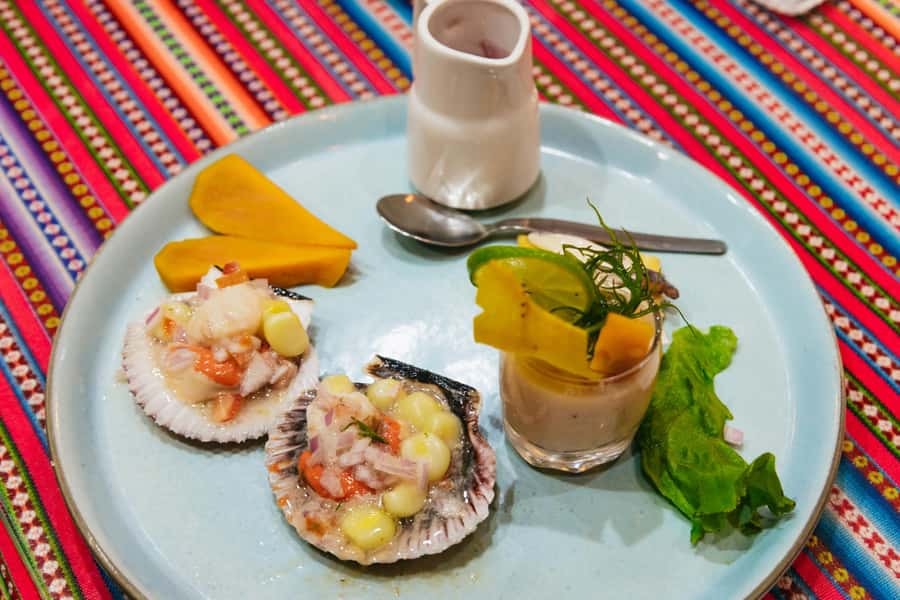
At present, cochayuyo is eaten fresh with ceviche, spicy foods and soups and also dried loose or in plants in urban centers in the highlands.
Tubers are preserved in different forms. Ocas (Oxalis tuberculosa) and machua (Tropaeolum tuberosa) they are dried in the sun and set out in the sun to make them sweeter and are then called cahui. However, the tuber that can keep for indefinite periods is the potato (Solanum tuberosa) which is submitted to a complicated process of dehydration. The bitter varieties are preferred and the task is carried out at four thousand meters above sea level.
The different kinds of chuño vary according to the qualities of the potatoes used, the most outstanding is muraya (the process generally takes several weeks). The potatoes are submerged in running water and then dried in the sun and exposed to the nocturnal frosts. The potatoes of sweet varieties are arranged by size on a flat surface exposed to the weather for four or five nights in the nocturnal cold and the burning sun of midday. Afterwards they are stepped on by the women so the peels fall off and the moisture is squeezed out. This is repeated until they finish drying.
There are a large number of edible plants whose use was restricted or which were used only in their ecological niches.
Subir
Painting
Painting as aesthetic expression was shown on murals and mantles. Bonavia indicates the difference between walls painted one or several colors and the murals with designs or motifs representing different scenes.
The painted murals are applied on walls plastered with mud using tempera paint, a technique different from that utilized for rupestrian paintings. Around the Early Horizon paint was applied directly on the plastered wall, while during the Early Intermediate Period the plastered wall was covered with white paint in order to later apply the desired drawing. Another medium used in the same epoch consisted of drawing motifs incised on damp mud in order to later fill the incisions with paint.
In the Moche epoch mural paintings and high relief paintings of mud such as those discovered in the Huaca de la Luna and the Huaca del Brujo in Chicama.
The technique and use of mantles painted on plain cotton cloth was the custom along the entire coast, with greater emphasis in the north. Around the years 1570 to 1577, there were still artists who specialized in the art of painting mantles and practiced their craft, traveling from one place to another. At that time these artists asked for license before the judge to use their art and go freely through the valleys without being hindered.
These mantles can be appreciated in museums and private collections. Perhaps they were used to cover naked walls or served as garments for important lords.
Another line within pictorial art was the execution of a sort of painted map which represented a place or a region. The chronicler Betanzos recounts that after the defeat of the Chancas inflicted by Prince Cusi Yupanqui, the Cuzco dignitaries presented themselves before him to offer him the tassel and they found him painting the changes he was thinking of introducing in Cuzco.
This notice would not be sufficient for confirming such a practice if it were not supported by another reference, the affirmation in the trial sustained by the ethnicities of Canta and of Chaclla in 1558-1570. One of the litigants presented there before the Royal Tribunal of Lima drawings of his valley indicating his territorial claims, while the second litigants exhibited a maquette of clay of the entire valley. Sarmiento de Gamboa said that on conquering a valley, they made a maquette and presented it to the Inca, who in front of those entrusted with executing the changes were informed of his desires.
Subir
Fertilizers
The importance of agriculture led the indigenous people to look for fertilizers for their crops. The information we possess about fertilizer comes from the coast and shows the use made of renewable natural resources
The main fertilizers used are named by the chronicler and were used especially for maize production which confirms Murra's suggestion regarding the priority of this crop.
A first fertilizer consisted of burying small fish like sardines or anchovies together with the kernels. A representation of this system was painted on the walls of one of the sanctuaries of Pachacamac where a maize plant was figured germinating from some little fish. The second fertilizer used was the dung of marine birds which nested by the thousands on the offshore islands. The resource called guano was formed by the dejections of the birds and it was the custom of the coastal people to extract guano from the islands. The third renewable resource came from the humus from fallen leaves of the carob and guarango trees used to improve soils.
Subir
Feather Art
Featherwork garments showed an aesthetic sense of color and feathers were used in mantles, shirts, fans, and parasols to keep personages carried in litters out of the sun. The brilliant tones of the feathers used indicate a jungle origin for which we conclude there must have been barter the length and breadth of the country between the jungle, the mountains and the coast.
The chronicler Santa Cruz Pachacuti tells that for grand events such as the wedding of Huayna Capac with his sister on the day he received the tassel or mascaipacha insignia of power, they covered the thatched roofs of the palaces and temples of Cuzco with the showiest mantles made of multicolored feathers. The spectacle must have been magnificent and surprising since the colors of the roofs counteracted the sobriety of the stones and the gold borders of the palatial walls
Subir
Terracing
Terraces have deserved extensive research and at present an attempt is being made to reconstruct them for agricultural benefit. Terraces permit cultivating steep slopes of ravines and prevent erosion produced by the rains.
The earth transported to the terraces after the construction of the stone walls and the hydraulic canal which carries water for irrigation from the first terrace to the last is worked with the chaki-taclla or taclla, the traditional indigenous foot plow which is the most appropriate tool for cultivating slopes.
On the coast some narrow terraces which lack water and irrigation canals were used as drying floors to dry some agricultural products such as aji or hot peppers (Capsicum sp.). An example of this are the terraces that are behind the building of Puruchuco in Lima. Others such as Carquin, near Huaura served for drying fish.
Subir
La Metallurgy
The Andean area of Peru, Bolivia and Ecuador was the cradle of metallurgy for all South America and it arose without any influence from the Old World.
There were two metallurgical centers, one on the Peruvian - Bolivian altiplano and the other on the north coast in the Mochica - Lambayeque region. From these two places knowledge spread south to Chile and Argentina, and north, to Colombia and Panama arriving later at the west coast of Mexico.
Metallurgy in Peru is of great antiquity and its skilled workmen knew the most varied techniques and alloys.
All along the coast there were expert silversmiths and during the Inca apogee the rulers established mitimaes in Cuzco to produce sumptuary objects. Various documents name the groups coming from Chimu, Pachacamac, Ica and Chincha. It is probable that their works followed the Inca aesthetic taste. We know of the establishment in Zurite, near Cuzco of silversmiths, yanas of Huayna Capac, originating from Huancavilca (now Ecuador) who resided on lands of the sovereign and whose obligation was to make objects for the Inca.
The presence of numerous indigenous silversmiths in Cuzco was subsequently taken advantage of by the Spanish judges, magistrates and colonialists who had been given grants of land with indigenous laborers by royal decree, to make personal gold and silver table service, mocking the obligation of the royal fifth. For this reason, pieces of silver from the sixteenth century in Peru that have been stamped are scarce